


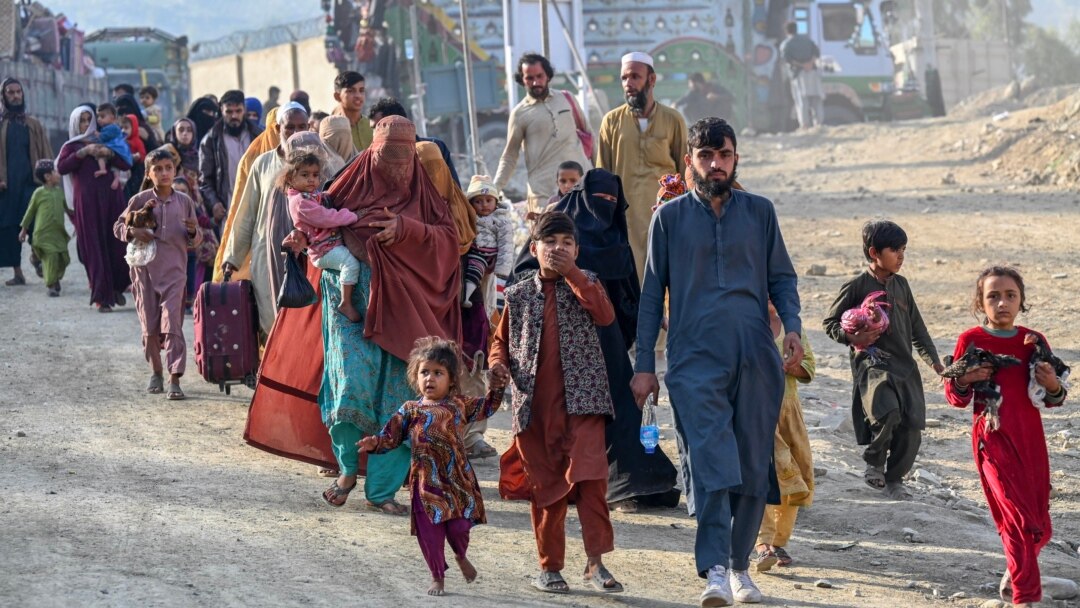
Along the borders of Iran with Afghanistan, and on the other side at Pakistan’s crossings with the country, Afghan families are being forcibly deported; families, some of whom have only heard the name “Afghanistan” and were born in the host countries but are now facing an unwanted return to their homeland.
Yasna, a returnee from Iran, said: “When we took bread, they would say, ‘Why are you taking more than two pieces?’ They harassed us like that. My father even had a passport, but they said it had to be issued by Iran.”
In Pakistan, according to reports from local newspapers, a campaign has been launched to persuade Afghans to leave their homes in the Khyber region and return to Afghanistan, aiming for the complete closure of 42 Afghan refugee camps that have been operational in Khyber Pakhtunkhwa over the past 55 years.
Pakistan’s Dawn newspaper reported: “This campaign began after police arrested nearly 30 undocumented Afghan refugees during an operation on Monday in Bara. On Tuesday, Deputy Commissioner Shahabuddin visited various parts of Landi Kotal, met with several Afghan families, and in a softer tone told them they must leave their homes before the start of arrest operations.”
Meanwhile, Iran, which implemented the “Return of Undocumented Foreign Nationals” plan on April 10, has now announced that 1.6 million undocumented Afghan nationals have been deported since the plan’s initiation, according to the Head of the Center for Foreign Nationals and Immigrants Affairs at Iran’s Ministry of Interior.
Naderyar Ahmadi, the head of the center, told Iranian media: “If we subtract the 1.6 million deported from the 6.1 million Afghan citizens present in the country, around 4.5 million remain. But considering illegal crossings at all borders, around 400,000 to 500,000 Afghans live in a floating status. Therefore, after the expulsion of undocumented Afghans, the average number of Afghan nationals in Iran is close to five million.”
Amnesty International, citing recent UN statistics, reported that over 2.6 million Afghans have been deported from Iran and Pakistan this year, with nearly 60% of returnees being women and children. The organization has called for an immediate halt to forced deportations of Afghan migrants, noting that these figures come at a time when Afghanistan is grappling with humanitarian and natural crises.
Zaman Sultani, South Asia researcher at Amnesty International, said: “In the current situation, Afghanistan needs humanitarian aid. This situation is worsening due to mass returns and forced expulsions. Additionally, the country is experiencing natural disasters.”
Previously, the Taliban had assured returning Afghans that the necessary support for restarting their lives would be provided. However, it has repeatedly urged host countries to stop the forced deportation of Afghan migrants.