


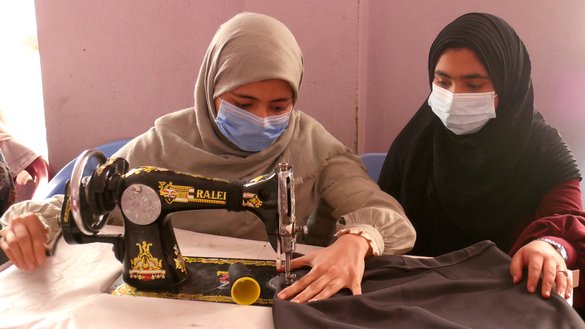
As restrictions on girls’ education in Afghanistan enter their fourth year, more than 100,000 women and girls have turned to handicrafts and home-based businesses in an effort to build livelihoods amid limited opportunities.
With secondary schools and universities still closed to girls, many have redirected their hopes and energy toward learning practical skills such as sewing, embroidery, tailoring, and small-scale production. While these activities provide a modest source of income, women say they are not a substitute for formal education.
Somaya, one of many young women affected by the ban, says sewing has helped her regain a sense of purpose. She earns enough to meet daily needs but continues to call for the reopening of schools. “After education was taken away, many girls faced serious mental health challenges. Learning a skill helped me cope, but education is still essential for our future and for serving our country,” she said.
For many, the shift to handicrafts was not a choice but a necessity. Rohina Nezami, who studied until 11th grade, dreamed of becoming a doctor. When schools closed, her plans were abruptly halted. “At first, I was confined to household duties. Later, I decided to learn sewing because it gave me something to hold on to,” she said.
According to women’s business representatives, the sector has grown rapidly since education and employment opportunities for women were curtailed. Fariba Noori, head of the Women’s Chamber of Commerce and Industries, says interest in handicrafts and small enterprises has surged nationwide. She notes that nearly 10,000 women now hold formal business or municipal licenses, while an estimated 100,000 others work informally across the country.
“These women are not only sustaining their families, but many are also becoming skilled entrepreneurs under extremely difficult conditions,” Noori said.
Despite this resilience, women emphasize that economic survival should not come at the cost of education. They argue that handicrafts and small businesses are coping mechanisms, not long-term solutions. With no clear indication of when schools and universities for girls might reopen, Afghan women continue to adapt — even as they call for the restoration of their fundamental right to learn.